You send a message to a colleague about a sensitive business deal. Two hours later, a competitor somehow knows the details. You never shared it anywhere else. You start wondering: can the platform read your messages?
This isn’t paranoia in China’s digital ecosystem. It’s a legitimate question most WeChat users never ask — until something goes wrong.
WeChat dominates Chinese daily life. With roughly 1.34 billion monthly active users, it handles everything from messaging to payments, mini programs, ride-hailing, and food delivery. For most Chinese smartphone users, switching away from WeChat feels about as practical as giving up a phone number.
BatChat (蝙蝠聊天) has spent years building a different proposition: a messaging app where privacy is the default, not the afterthought. Developed by Chengdu Feifu Technology (成都飞蝠科技有限公司), BatChat encrypts everything on-device before transmission and claims zero server-side data storage (服务器零数据存储).
These two apps represent opposite ends of China’s messaging spectrum. WeChat is the everything app — convenient, integrated, and deeply embedded in Chinese infrastructure. BatChat is the privacy-first messenger — narrower in scope, but fundamentally different in how it handles your data.
This comparison breaks down what actually matters: encryption architecture, what data each company collects, how features stack up for daily use, and which app makes sense for which person.
Encryption: The Core Difference
The single biggest technical gap between these two apps comes down to one question: can the company read your messages?
WeChat’s Encryption: Transit-Only Protection
WeChat encrypts messages between your device and WeChat’s servers. According to WeChat’s own help center, it “securely encrypts your sent and received messages between our servers and your device to help prevent unauthorized third parties from intercepting your messages as they are being delivered over the internet.”
That phrasing matters. WeChat protects messages in transit — the same way HTTPS protects your browsing. But once messages reach WeChat’s servers, they are decrypted, processed, and stored. WeChat’s servers need access to plaintext to deliver messages, sync across devices, and support features like search and message backup.
WeChat does not offer end-to-end encryption for any conversation type. Tencent has never publicly claimed otherwise.
What this means in practice: Tencent can access the content of every message sent through WeChat. Whether they do is a policy question. Whether they can is an architectural fact.
BatChat’s Encryption: Device-to-Device by Default
BatChat’s approach flips the model. All messages — text, images, voice, video, files — are encrypted on the sender’s device before transmission. The encrypted data passes through BatChat’s servers (which relay it to the recipient) but the servers never hold the decryption keys.
The encryption stack uses three layers:
- RSA for initial key exchange — establishes a shared secret between two parties without exposing it to the server.
- SRP (Secure Remote Password) for authentication — verifies user identity without the server ever seeing the actual password.
- Double Ratchet for forward secrecy — every message gets a unique encryption key, so compromising one message doesn’t compromise the conversation history.
BatChat claims the server performs zero data storage. After delivery, encrypted packets are discarded. The only copies of your messages exist on your device and the recipient’s device.
There’s a catch: BatChat is closed source. Unlike Signal (fully open source) or even Telegram (client code is open), BatChat’s code cannot be independently audited. You’re trusting the company’s claims about its architecture.
| Encryption Aspect | BatChat | |
|---|---|---|
| Default encryption type | Client-server (transit only) | End-to-end (client-side) |
| Can the company read messages? | Yes — servers process plaintext | No — server never holds keys |
| Forward secrecy | Not implemented | Double Ratchet (per-message keys) |
| Multi-device sync | Yes (cloud-based) | Yes (encrypted sync) |
| Open source | No | No |
| Independent security audit | None published | None published |
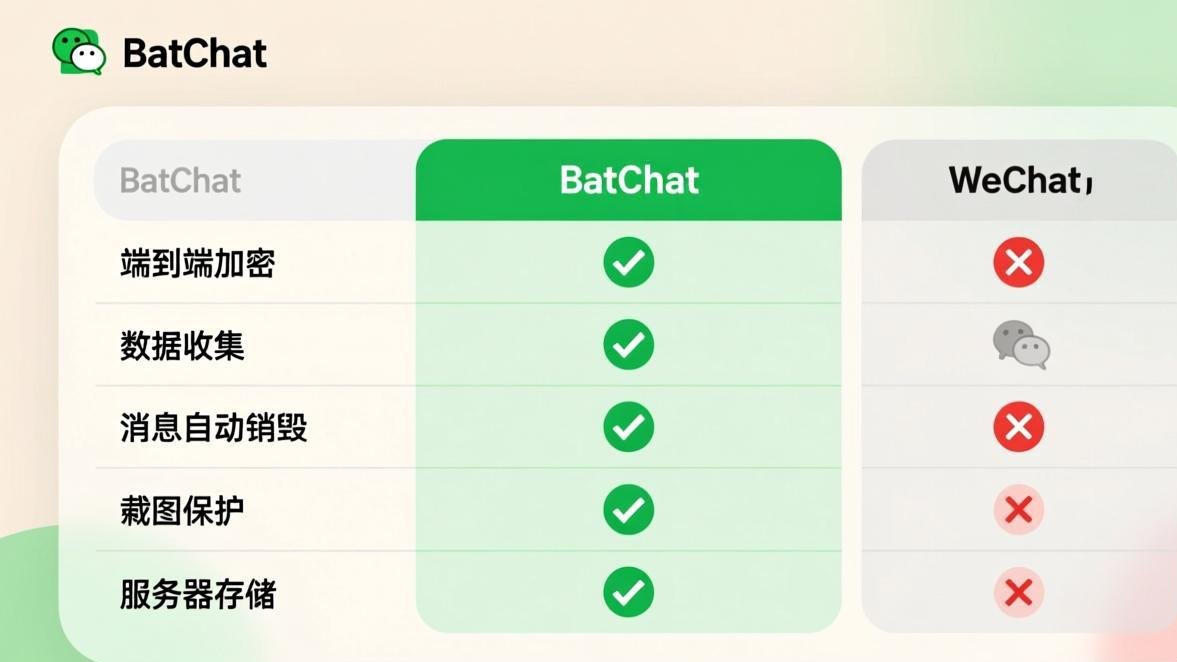
The encryption difference is binary: WeChat has access to your messages. BatChat doesn’t. Everything else follows from that.
Data Collection and Privacy
Encryption is one part of privacy. Data collection is the part that often matters more for day-to-day users.
What WeChat Collects
WeChat’s privacy policy and terms of service allow collection of:
- Phone number — mandatory for registration
- Contact list — if you grant permission
- Location data — derived from IP address, GPS, and device sensors
- Device information — model, OS version, unique device identifiers
- Message content — all text, images, voice, and video messages (stored on servers)
- Payment data — transaction history through WeChat Pay
- Mini program usage — which apps you use, how long, what you do
- Moments (朋友圈) activity — posts, likes, comments
- Browsing history — articles read through WeChat’s built-in browser
- Facial recognition data — if used for identity verification
WeChat is owned by Tencent, a Shenzhen-based company fully subject to Chinese law. Under China’s National Security Law (2015), Cybersecurity Law (2017), Data Security Law (2021), and the Personal Information Protection Law (PIPL, 2021), Chinese authorities can compel technology companies to provide user data for law enforcement and national security purposes.
The University of Alberta’s IT security guidance for travelers to China is blunt: “Assume all conversations are monitored, and data collected may be shared with the Chinese government under its National Security laws.”
A Penn State Dickinson Law analysis of WeChat’s data practices notes that the “super app” model — where one platform handles messaging, payments, identity verification, and social media — creates an unusually comprehensive data profile of each user.
What BatChat Collects
BatChat’s data collection is dramatically narrower because of the architectural choice to encrypt everything client-side:
- Phone number — required for registration (same as WeChat)
- Device information — limited, for push notification delivery
- App usage metrics — crash reports and basic analytics (common to all apps)
The developer states that BatChat stores zero message content on servers. Encrypted packets are relayed, not retained. Without stored content, there is nothing to hand over — even under legal compulsion.
However, BatChat operates under the same Chinese legal framework as Tencent. The company is registered in Chengdu with ICP filing (蜀ICP备19040194号). If Chinese authorities demanded that BatChat modify its architecture to enable message interception, the company would face the same pressure as any other Chinese technology firm.
The practical difference is that BatChat would need to fundamentally redesign its product to comply with a surveillance demand — it can’t simply hand over stored data because no data is stored. This architectural resistance (sometimes called “security by design”) creates a higher barrier than a policy promise.
Several international organizations, including the University of Alberta, now recommend that travelers to China use encrypted messaging apps specifically because platforms like WeChat lack end-to-end encryption by default. Encrypted alternatives provide a technical barrier that policy promises alone cannot match.
Jurisdiction and Corporate Control
Both companies are Chinese, registered in China, and subject to Chinese law. Neither is outside the reach of Chinese authorities. The difference isn’t jurisdiction — it’s architecture.
Tencent has built WeChat as a data-rich platform: messages are stored, analyzed, and monetized indirectly through targeted advertising, payment processing, and the broader Tencent ecosystem. BatChat has built its product so that the company cannot read user messages even if it wanted to — assuming the zero-storage claim is accurate.
For users considering a switch, the 1Password privacy team and other security professionals recommend looking at what a company can access, not just what its privacy policy promises.
Feature Comparison
Privacy matters, but apps also need to do the things people actually use them for.
Messaging and Media
WeChat offers the full messaging suite: text, voice messages, images, video, stickers, location sharing, file transfer (up to 200 MB per file), and video/voice calls. Messages sync across all devices through Tencent’s cloud infrastructure. You can search your entire message history, back it up, and restore it on a new device.
BatChat supports text, voice, images, video, files, and encrypted voice/video calls. Messages sync across devices with the same end-to-end encryption applied. The file transfer limit is not publicly documented but is understood to be comparable to other messengers.
Where BatChat differs is in privacy-specific features that WeChat doesn’t offer:
- Screenshot blocking — prevents the other party from taking screenshots of your conversation (OS-level enforcement).
- Screen recording protection — blocks screen recording during sensitive chats.
- Preset passwords (预设密信) — lock individual conversations behind a custom passphrase, separate from the app lock. Even someone holding your unlocked phone can’t open protected chats.
- Self-destructing messages — messages automatically delete after a configurable time.
- App lock — face ID, fingerprint, or PIN before the app opens.
WeChat has none of these. A WeChat conversation can be screenshotted, forwarded, and shared without any technical limitation. The only protection is trust in the person you’re talking to.
Groups
WeChat groups are ubiquitous in Chinese life — work projects, family chats, neighborhood groups, hobby communities. WeChat supports groups up to 500 members. Group features include @mentions, pinned messages, group announcements, and location sharing.
BatChat groups emphasize encrypted communication with member protection features. Key BatChat-specific group features include:
- All group messages are end-to-end encrypted by default
- Group member protection (群成员保护)
- In-group voting
- Screenshot and recording protection applies to groups
- Preset passwords work for group conversations
- Stacked message display for busy groups (叠楼消息显示)
The maximum BatChat group size is not publicly documented but appears to be smaller than WeChat’s 500-member cap.
For encryption-focused users, BatChat’s group model is stronger — every member’s messages are protected, not just one-on-one chats. For scale and everyday convenience, WeChat’s groups are far more established.
Payments
WeChat Pay is one of China’s two dominant payment systems (alongside Alipay). Roughly 935 million people use WeChat Pay. It handles everything from supermarket checkout to utility bills, taxi fares, movie tickets, and peer-to-peer transfers. For daily life in China, WeChat Pay is effectively essential.
BatChat does not offer payment features. This is the single biggest functional gap between the two apps, and for many Chinese users, it’s a dealbreaker. If you need to pay for things through your messaging app, you need WeChat (or Alipay).
Mini Programs and Ecosystem
WeChat’s mini programs (小程序) are effectively an operating system within the app. With over 4.1 million registered mini programs and roughly 945 million monthly active users, they cover:
- Ride-hailing (Didi)
- Food delivery (Meituan)
- E-commerce (JD, Pinduoduo)
- Government services (health codes, tax filing)
- Banking and investments
- Gaming
- Travel booking
- Doctor appointments
Many daily tasks that would require separate apps in other countries happen entirely within WeChat. This integration is genuinely useful — it also means WeChat sees everything you do.
BatChat has no mini program ecosystem. It’s a messaging app. If you want to order food, pay a bill, or book a train ticket, you’ll need another app (probably WeChat).
Voice and Video Calls
Both apps support voice and video calls. WeChat’s call quality is generally excellent, running on Tencent’s infrastructure with millions of concurrent calls. BatChat’s calls are end-to-end encrypted, which adds some overhead but keeps call content private.
Anecdotal reports suggest BatChat’s HD calling works well on Chinese networks, though call quality depends on both parties’ connection quality as with any VoIP service.
Platform Availability
Both apps are available on iOS and Android. Both work natively in China without VPN.
WeChat also offers desktop clients for Windows and Mac, plus a web version (WeChat Web). The desktop experience is full-featured, supporting file transfers, Moments, and most core features.
BatChat offers desktop clients for Windows and Mac, plus a web client. The desktop experience is focused on messaging and file transfer rather than the broader social features WeChat provides.
Bot and Developer Ecosystem
WeChat has an extensive developer ecosystem including Official Accounts (公众号) for content publishing, enterprise APIs, customer service bots, and the mini program development platform. Businesses build entire customer-facing operations on WeChat.
BatChat has a more limited open platform primarily focused on enterprise integration and custom deployments, not the broad consumer developer ecosystem that WeChat provides.
| Feature | BatChat | |
|---|---|---|
| Text, voice, video messaging | ✓ | ✓ |
| Voice and video calls | ✓ | ✓ (encrypted) |
| File transfer | Up to 200 MB | Supported |
| Message search | Full history | Limited (local only) |
| Cloud backup | Yes | No (zero server storage) |
| Screenshot protection | No | ✓ |
| Screen recording protection | No | ✓ |
| Preset passwords | No | ✓ |
| Self-destructing messages | No | ✓ |
| Payment system | WeChat Pay (935M users) | No |
| Mini programs | 4.1M+ programs | No |
| Moments (social feed) | Yes | No |
| Groups (max size) | 500 members | Not documented |
| Desktop apps | Windows, Mac, Web | Windows, Mac, Web |
| Works in China without VPN | Yes | Yes |
Who Should Use WeChat
WeChat is the default for a reason. It’s good at what it does:
- You need the everything-app: messaging, payments, mini programs, social feed, all in one place.
- You use WeChat Pay daily — switching away isn’t practical if you need to pay for things.
- Your entire social and professional network is on WeChat.
- You run a business that depends on WeChat Official Accounts or mini programs.
- You don’t have specific privacy concerns that outweigh convenience.
- You trust Tencent’s data handling policies.
For most people in China, WeChat isn’t really a choice. It’s infrastructure. You use it because everyone else uses it, and because it handles too many daily functions to give up.
Who Should Use BatChat
BatChat makes sense when privacy is a priority, not just a preference:
- You handle sensitive business information that shouldn’t pass through corporate servers.
- You want conversations that can’t be screenshotted or forwarded without your knowledge.
- You’re discussing topics where server-side message access is a genuine concern.
- You want a secondary messaging app for private conversations, while keeping WeChat for everyday life.
- You need end-to-end encryption by default, not as an opt-in feature buried in settings.
- You want the ability to lock individual chats behind a separate password (preset passwords).
A practical approach many users take: keep WeChat for payments, mini programs, and group chats with acquaintances. Use BatChat for one-on-one conversations, sensitive work discussions, and any communication where privacy matters more than the WeChat ecosystem’s convenience.
The Practical Reality: Both Apps, Different Purposes
For users who can only pick one, WeChat wins on functionality. It does more things, connects to more people, and is embedded in daily Chinese life in ways BatChat isn’t designed to replicate.
But “pick one” is the wrong framing. These apps serve different purposes. WeChat is the public square — your visible, connected, everything-in-one-place digital life. BatChat is the private room — encrypted, screenshot-protected, where conversations stay between you and the person you’re talking to.
The real comparison isn’t “WeChat vs BatChat — which is better?” It’s “what kind of conversation belongs where?”
A lawyer discussing case details with a client. A journalist protecting a source. A business owner negotiating a deal. A couple having a private conversation. A doctor discussing patient information. These are all scenarios where WeChat’s server-side message access creates real risk — and where BatChat’s architecture eliminates it.
For everything else — ordering lunch, paying rent, sharing vacation photos in a family group, reading news articles — WeChat already does the job.
Summary
The differences come down to a few fundamentals:
Encryption: BatChat encrypts everything end-to-end, by default. WeChat encrypts in transit but servers can read your messages. This is the architectural line dividing the two apps.
Data collection: WeChat collects comprehensive data across messaging, payments, location, browsing, and social activity. BatChat collects a phone number and basic device info — the rest never reaches its servers in readable form.
Features: WeChat is an everything-app with payments, mini programs, social feed, and a developer ecosystem. BatChat is a messaging app with strong privacy protections. If you need payments and mini programs, you need WeChat. If you need private conversations, BatChat delivers what WeChat architecturally cannot.
Privacy defaults: BatChat’s entire design philosophy is privacy-first — encryption is forced, not offered as an option. WeChat’s design philosophy is convenience-first — everything syncs, everything is searchable, everything is accessible, because servers hold the keys.
For Chinese users weighing these two options, the practical answer isn’t to choose one. It’s to understand what each app does well, and use the right tool for the right conversation. WeChat for daily life. BatChat for conversations where privacy isn’t negotiable.
FAQ
Does WeChat have end-to-end encryption?
No. WeChat encrypts messages between your device and its servers (in-transit encryption), but messages are decrypted and stored on WeChat’s servers. End-to-end encryption — where only the sender and recipient can read messages — is not available on WeChat. BatChat applies end-to-end encryption to all messages by default.
Can the Chinese government read WeChat messages?
WeChat’s architecture allows Tencent to access message content on its servers. China’s National Security Law, Cybersecurity Law, and other regulations provide legal mechanisms for authorities to request user data from technology companies. Whether specific messages are accessed depends on individual circumstances, but the technical capability exists. BatChat’s zero-server-storage model eliminates this possibility for message content.
Do I need VPN to use BatChat in China?
No. BatChat operates natively on Chinese networks without VPN. It is available through Chinese app stores and registered with ICP filing in Sichuan province. This is a practical advantage over international encrypted messengers like Signal or Telegram, which are blocked in China and require VPN.
Can I use both WeChat and BatChat?
Yes. Many users keep WeChat for daily functions (payments, mini programs, social groups) and use BatChat for sensitive conversations. The two apps serve different purposes and complement each other rather than competing directly.
Is BatChat open source?
No. Unlike Signal, BatChat’s source code is not publicly available for independent audit. The security claims (zero server storage, client-side encryption) must be taken on trust. WeChat is also closed source.
Does BatChat collect less data than WeChat?
By design, yes. WeChat collects messaging content, payment history, location data, browsing history, mini program usage, Moments activity, device information, and contact lists. BatChat’s server processes only encrypted data — the company claims it stores zero message content and collects minimal metadata (phone number, basic device information for push notifications).